Buying a pre-construction condo in Florida is different from buying a completed resale condo.
A buyer may select a residence years before the development is finished, make deposits over time, review a developer-drafted contract and disclosure package, make design selections during construction, and eventually close after the residence is ready for occupancy.
For many buyers, the process begins with a development. They see a new project online, hear about it from someone they know, visit a sales gallery, or discover it while spending time in a Florida market. From there, they begin evaluating available residences.
That is the traditional path.
Understanding how that process works is important before deciding whether there may be a better way to approach it.
In simple terms, Florida pre-construction condo buying typically moves from development selection to residence reservation, contract review, staged deposits, construction, final walkthrough, and closing. CondoIQ changes the journey by starting with the buyer, adding boots-on-the-ground Recon and attorney document review, and extending support beyond closing.
1. Discover a Development
Most pre-construction purchases begin with a particular development.
The buyer may be attracted by:
- Location
- Architecture
- Waterfront position
- Amenities
- Developer reputation
- Floor plans
- Views
- Pricing
- Expected completion timing
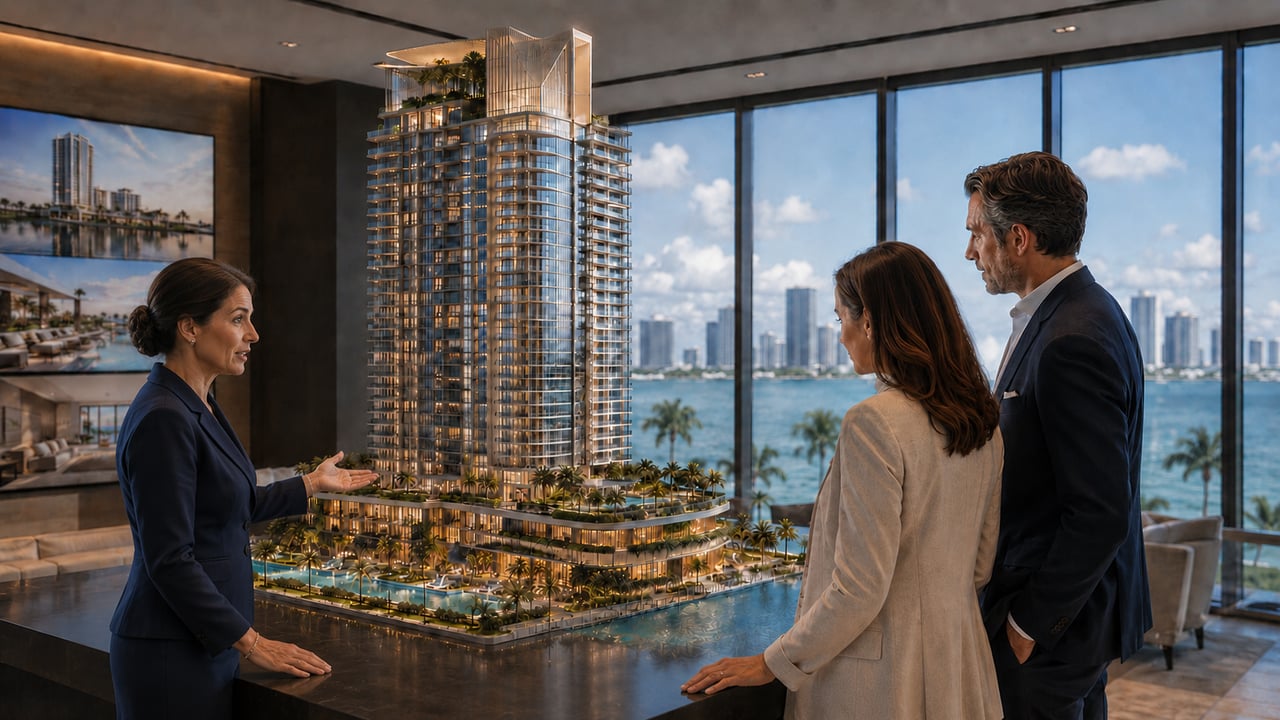
At this stage, buyers are often evaluating the opportunity through renderings, websites, brochures, model residences, sales presentations, and other developer materials.
Those resources are useful, but they naturally focus on the development being sold.
2. Select a Residence
Once a buyer becomes interested in the development, attention shifts to the available residences.
Important considerations can include:
- Floor plan
- Square footage
- Floor level
- Orientation
- View corridor
- Balcony configuration
- Parking
- Storage
- Elevator proximity
- Finish package
- Surrounding future development
In many projects, preferred combinations of floor plan, view, and location within the development can be selected early.
3. Reserve the Residence
Some Florida developments use a reservation agreement before the formal purchase contract.
The reservation may identify the residence, establish an initial deposit, and hold the opportunity for a specified period while the developer prepares or releases the purchase agreement.
Before signing, buyers should understand:
- Whether the reservation deposit is refundable
- How long the reservation lasts
- When the formal purchase agreement will be issued
- Whether the residence and purchase price are fixed
- Whether parking or storage is included
- When additional deposits will be required
The reservation is only the beginning. The developer purchase agreement ultimately establishes the buyer’s contractual obligations.
4. Review the Developer Contract and Disclosure Package
Developer contracts differ substantially from ordinary resale contracts.
Under current Florida law, a residential condominium buyer purchasing from a developer generally has 15 days to cancel after executing the agreement and receiving the required developer documents. Certain amendments that materially and adversely change the offering can also create additional cancellation rights.
The disclosure package may include items such as:
- Declaration of condominium
- Articles and bylaws
- Rules
- Proposed operating budget
- Prospectus or offering statement
- Purchase agreement
- Floor plans
- Plot plans
- Applicable covenants and restrictions
The contract may address:
- Construction timing
- Permissible delays
- Deposits
- Escrow provisions
- Design changes
- Developer modification rights
- Assignment rights
- Parking and storage
- Closing requirements
- Buyer default
- Developer remedies
Florida law also warns buyers that figures contained in a developer-prepared condominium budget are estimates and that actual future expenses may be higher. Buyers can review the applicable disclosure provisions in Florida Statute 718.503.
Because these documents establish significant legal and financial obligations, legal review is an important part of a pre-construction purchase.
5. Make Staged Deposits
Pre-construction purchases commonly involve multiple deposits before closing.
A project might require:
- An initial reservation or contract deposit
- An additional deposit after contract execution
- One or more later construction-stage deposits
- The remaining purchase balance at closing
The actual percentages and timing vary by development.
Buyers should understand not only the purchase price, but also how much liquidity will be committed before completion and when each payment becomes due.
That becomes particularly important when the buyer expects to sell another property, liquidate investments, or rely on future cash flow to fund later deposits.
6. Follow Construction and Make Design Selections
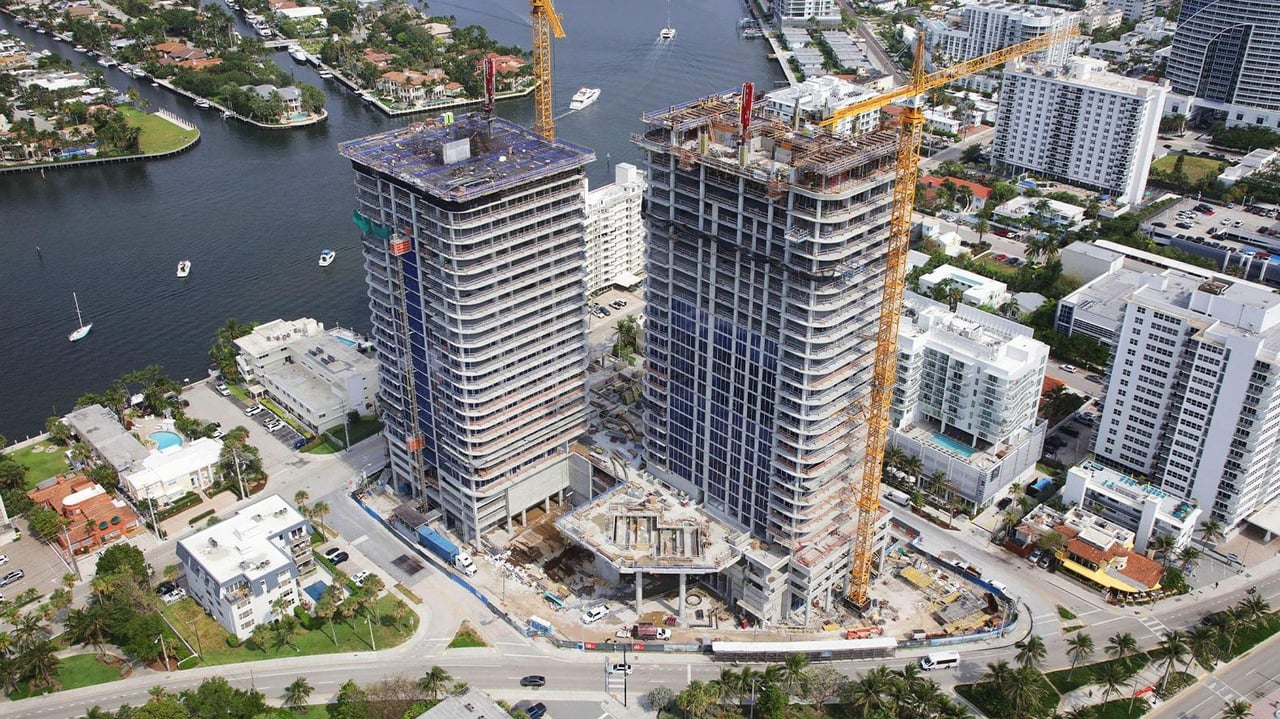
Once under contract, the buyer enters the longest stage of the process.
Construction timelines can change because of:
- Permitting
- Weather
- Labor availability
- Material availability
- Inspections
- Utility work
- Construction sequencing
- Other project conditions
Some developments also allow buyers to select finish packages or make limited upgrades.
Keep records of:
- Developer updates
- Deposit confirmations
- Finish selections
- Change orders
- Amendments
- Correspondence affecting the residence
- Revised completion estimates
An estimated completion date should be treated as a planning target, not necessarily a guaranteed move-in date unless the contract specifically provides otherwise.
7. Prepare for Completion
As construction approaches completion, several moving parts begin converging.
The buyer may need to coordinate:
- Insurance
- Title
- Closing funds
- Final walkthrough
- Parking and storage confirmation
- Move-in procedures
This phase can move quickly after a long period of waiting.
Buyers who need to sell another residence should pay particular attention to timing. Selling too early can create an unnecessary housing gap, while waiting too long can create liquidity or closing pressure.
8. Complete the Final Walkthrough
Before closing, buyers generally inspect the residence and identify incomplete or defective items for a punch list.
Items may include:
- Cabinetry
- Flooring
- Paint
- Appliances
- Plumbing fixtures
- Doors
- Windows
- Electrical components
- Finish workmanship
The purpose of the walkthrough is to evaluate the residence being delivered against the contracted plans, selections, and expected condition.
9. Close and Transition Into Ownership
At closing, title transfers and the remaining purchase funds are paid.
The buyer then moves from the developer-sales and construction phase into condominium ownership.
The developer may initially control the condominium association before control later transitions to unit owners under Florida law and the governing documents.
Buyers should also recognize that projected association expenses may change as the development becomes operational and actual expenses replace earlier estimates.
Where the Traditional Process Has Blind Spots
The traditional pre-construction process is not inherently wrong.
But it commonly leaves important parts of the buyer journey underdeveloped.
The process usually begins with a development. From there, the buyer evaluates residences, enters a contract, follows construction, and closes.
CondoIQ approaches three major stages of that journey differently:
Front End: Start With the Buyer | Matching
Middle: Boots-on-the-Ground Recon + Attorney Document Review
Back End: Move-In Concierge Support
Front End: Start With the Buyer | Matching
CondoIQ starts with the buyer, not the building.
The first question is not:
Which development do you like?
It is:
How do you want to live?
Florida’s condo-rich cities are not interchangeable.
Miami does not live like Naples. Naples does not live like St. Petersburg. Sarasota, Fort Lauderdale, Palm Beach, Fort Myers and Estero, Orlando and the Walt Disney World area, and Florida’s other condo markets each have their own pace, personality, walkability, waterfront experience, culture, dining, business environment, recreation, travel access, and seasonal rhythm.
Explore those differences through CondoIQ’s Florida Condo Markets page.
That matters because a buyer can choose an extraordinary residence in an extraordinary development and still make a major financial and lifestyle mistake if the city and surroundings are wrong.
The CondoIQ Match organizes buyer priorities across factors such as:
- Preferred lifestyle
- Florida city
- Surrounding environment
- Waterfront preferences
- Walkability
- Amenities
- Boating
- Golf
- Pets
- Residence type
- Budget
- Timing
- Ownership goals
The objective is to identify the city and surroundings that fit first, then narrow toward developments and residences.
That changes the beginning of the sequence from:
Development → Residence
to:
Buyer → City → Surroundings → Development → Residence
For a statewide Florida condo buyer, getting the city wrong can be a much larger financial and lifestyle mistake than choosing the wrong floor plan.
Middle: Boots-on-the-Ground Recon + Attorney Document Review
Once promising developments emerge, CondoIQ adds more depth to the traditional process.
The middle of the CondoIQ journey includes two important layers:
Boots-on-the-Ground Recon
Attorney Document Review
Together, they help pressure-test the opportunity before the buyer moves deeper into the purchase.
Boots-on-the-Ground Recon
Developer marketing, renderings, websites, AI research, video calls, and sales-gallery presentations can all provide useful information.
But they cannot fully replace being physically present at the development and in its surroundings.
In dense Florida condo markets, the surroundings can matter almost as much as the development itself. A tower may look extraordinary in isolation while the immediate area creates noise, congestion, construction exposure, nightlife intensity, traffic concerns, or future view changes that materially affect the ownership experience.
Boots-on-the-ground Recon looks beyond the sales presentation and evaluates the opportunity in its real-world setting.
Depending on the development and the buyer’s priorities, Recon may examine:
- What sits directly across the street
- Immediate block conditions
- The surrounding neighborhood
- Nearby nightlife and late-night activity
- Highway and major-road proximity
- Traffic, loading, service, and access patterns
- Nearby construction
- Active and planned high-rise development
- Potential future view obstruction
- View corridors
- Neighboring properties
- Waterfront conditions
- Walkability and pedestrian environment
- Noise sources
- Construction progress
- Lifestyle fit
- Buyer-specific tradeoffs
What sits directly across the street and what is unfolding in the surrounding blocks can matter significantly to how a condo feels to live in.
Zoom cannot walk the neighborhood. Renderings cannot show you everything immediately surrounding the development. AI cannot physically inspect the area. And an advisor who is not on-site cannot deliver true boots-on-the-ground Recon.
The question is not simply:
Is this a good development?
The better question is:
Is this the right development for this buyer?
Attorney Document Review
Pre-construction purchases involve much more than a purchase agreement.
The buyer may receive a substantial package of developer and condominium documents containing legal rights, financial obligations, use restrictions, deposit provisions, budgets, association rules, and other terms that can materially affect the purchase and future ownership experience.
As part of the CondoIQ process, buyers can have their developer contract and condominium documents reviewed by experienced Florida real estate attorneys at Berlin Patten Ebling.
The legal review may address documents and provisions such as:
- Developer purchase agreement
- Prospectus or public offering materials
- Declaration of condominium
- Articles and bylaws
- Proposed operating budget
- Rules and use restrictions
- Deposit provisions
- Assignment rights
- Parking and storage rights
- Developer modification provisions
- Closing obligations
- Other transaction-specific documents
The purpose is not simply to determine whether a contract can be signed.
It is to help the buyer understand the legal structure of the purchase before a major commitment becomes final.
Developer marketing explains the opportunity.
Attorney document review helps explain the obligations.
Back End: Move-In Concierge Support
CondoIQ also changes where the process ends.
In a traditional transaction, closing is usually the finish line.
With CondoIQ, the experience extends into the buyer’s transition to the new residence through Move-In Concierge Support.
A new Florida condo can require an entirely new network of local resources, particularly for buyers relocating from another city or state.
Move-In Concierge Support can help connect buyers with trusted professionals and service providers appropriate to their transition and new residence.
Depending on the buyer’s needs, that may include resources related to:
- Moving
- Interior design
- Home technology
- Window treatments
- Furniture and installation
- Home services
- Other local needs associated with settling into the residence
The objective is to make the transition into the new home part of the CondoIQ experience rather than treating closing as the end of it.
Traditional Pre-Construction vs. CondoIQ
The traditional journey often looks like this:
Development → Residence → Reservation → Contract → Deposits → Construction → Closing
The CondoIQ journey expands that sequence:
Buyer → City → Surroundings → Development → Residence → Boots-on-the-Ground Recon → Attorney Document Review → Financing Options → Contract → Construction → Closing → Move-In Concierge Support
The legal purchase process still occurs.
The difference is what CondoIQ adds around it.
CondoIQ changes the front end through Matching, strengthens the middle with boots-on-the-ground Recon and attorney document review, and extends the back end beyond closing with Move-In Concierge Support.
Start With the Buyer
Florida has an expanding landscape of new-construction and pre-construction condominium opportunities.
More choice is valuable.
It also creates more opportunities to make an expensive mismatch.
A rendering can show what a development is designed to look like.
A sales gallery can explain its residences and amenities.
Neither can determine whether Miami, Naples, Sarasota, St. Petersburg, Fort Myers and Estero, Orlando and Walt Disney World, Palm Beach, Fort Lauderdale, or another Florida market best fits how you want to live.
That decision starts with you.
When you are ready to narrow Florida’s condo market around your lifestyle, priorities, budget, timing, and ownership goals, Start your CondoIQ Match.
FAQs
How does pre-construction condo buying usually begin in Florida?
Most buyers first discover a particular development, then evaluate available residences, reserve a unit, review the developer contract and disclosure package, make required deposits, follow construction, and close when the residence is ready.
How long can a Florida pre-construction condo purchase take?
It depends on when the buyer enters the development. Someone purchasing early may wait several years for completion, while a buyer entering later in construction may close much sooner.
How much deposit is required?
Deposit structures vary by development. Many projects use staged deposits before completion rather than collecting the buyer’s entire contribution at closing.
Can I cancel a Florida developer condo contract?
Florida law generally gives a residential buyer 15 days to cancel after execution of the developer contract and receipt of the required documents. Certain materially adverse amendments can create additional cancellation rights.
What is the biggest mistake buyers make with Florida pre-construction condos?
One of the biggest mistakes is starting with a development before deciding which Florida city, surroundings, lifestyle, and ownership experience best fit the buyer. CondoIQ reverses that sequence by starting with the buyer first.
Why does CondoIQ start with the Buyer, not the building?
Because the right condo starts with how the buyer wants to live. Florida’s condo-rich cities offer very different lifestyles, surroundings, and ownership experiences, so CondoIQ first identifies the buyer’s priorities, then narrows toward the right city, surroundings, development, and residence.
What is CondoIQ Boots-on-the-Ground Recon?
Recon is an on-site research layer used to look beyond developer marketing and evaluate the development, immediate surroundings, neighboring activity, construction, access, potential view impacts, lifestyle considerations, and buyer-specific fit in the real world.
Who reviews the legal documents for CondoIQ buyers?
CondoIQ buyers can have applicable developer contracts and condominium documents reviewed through Berlin Patten Ebling, a Florida real estate law firm.
Does CondoIQ support buyers after closing?
Yes. Move-In Concierge Support extends the experience beyond closing by helping buyers connect with trusted local professionals and service providers as they transition into the new residence.